Shawl Lapel Guide: What It Is, and Exactly When to Wear One
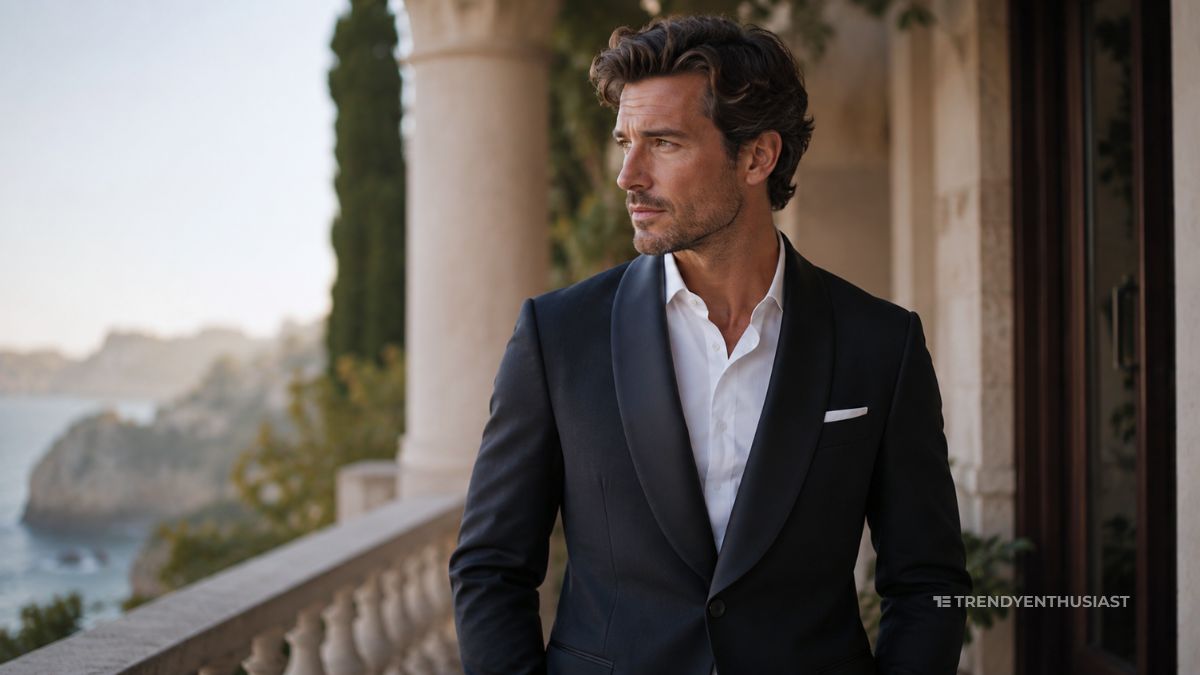
A shawl lapel is a suit or tuxedo lapel with no notch and no point just one continuous curved edge running from the collar down to the button. It’s the most formal of the three lapel styles and belongs almost exclusively on tuxedos and dinner jackets. If you’re deciding whether to wear one: choose shawl for black-tie and evening formalwear, and leave it out of the office entirely.
What Is a Shawl Lapel?
A shawl lapel is defined by its unbroken curve: the fabric runs from the back collar seam, around the neck, and down to the button closure without a notch or angled point interrupting it. Where a peak lapel juts outward and a notch lapel cuts a small V, a shawl lapel simply flows, soft, rounded, continuous.
Structurally, this comes from the fact that a shawl lapel and the collar are cut as one piece of fabric rather than two separate pieces sewn together. That’s the technical reason it looks seamless: it is.
The shawl lapel didn’t start as formalwear. It originated on Victorian smoking jackets which gentlemen wore after dinner specifically to keep smoke and ash off their formal clothes. The rounded collar-lapel was built for comfort, not ceremony.
The formal version traces to 1865, when the Prince of Wales asked his tailor for a shorter, tailless alternative to the traditional dinner tailcoat modeled on the smoking jacket he already wore comfortably at home. That garment became the first modern dinner jacket, and it had a shawl lapel from day one. In that sense, the shawl lapel isn’t a variation on the tuxedo, it’s the original tuxedo lapel, with peak arriving later.
Its status was cemented decades later on screen, worn by Fred Astaire, Cary Grant, and Sean Connery’s Bond which is a large part of why it still reads as effortlessly elegant rather than costume-formal today.
Shawl Lapel Formality: Where It Sits
A shawl lapel is the most formal of the three lapel styles, reserved almost entirely for black-tie and white-tie evening wear. It has no place on a business suit, an interview, or daily office wear.
This is the one clear line separating shawl from its peak and notch counterparts: a notch lapel scales from casual to business-formal, and a peak lapel scales from business-formal to black-tie but a shawl lapel doesn’t scale at all. It has one register: formal evening wear.
Shawl Lapel Width and "Belly": Getting Proportions Right
Shawl lapel width and curve (“belly”) change the whole character of a tuxedo, and most guides skip this entirely.
Width:
Slim (2.5–3″) – modern, minimal, works best on leaner frames
Medium (3–3.75″) – the safe, classic default for most men
Wide (4″+) – vintage-leaning, bold, best on broader or taller builds
Belly (the curve of the lapel):
Flat belly – a subtle, near-straight curve; clean and modern, common on contemporary tuxedos
Medium belly – a gentle, balanced curve; the most versatile option for dinner jackets
Full belly – a pronounced, dramatic curve; old-Hollywood in feel, suits velvet and statement fabrics
Match width to build the same way you would with a peak lapel but keep the belly conservative (flat to medium) unless the whole outfit is leaning vintage.
Shawl Lapel Fabric: Satin, Grosgrain, or Matching Cloth
Almost every shawl lapel tuxedo uses a facing i.e a layer of shiny fabric over the lapel that contrasts with the matte wool or cotton body of the jacket. The two standard options:
Satin – glossier, more reflective, the more common modern choice
Grosgrain – a ribbed, matte-finish silk with a more subdued sheen, considered slightly more traditional
Velvet shawl lapel jackets are the exception here, the lapel is usually self-faced in the same velvet as the body, since velvet already carries enough visual richness on its own.
When to Wear a Shawl Lapel
Wear a shawl lapel for:
Black-tie events – paired with a bow tie, it’s the definitive black-tie combination
Weddings – for grooms or guests at formal evening ceremonies
Galas and formal dinners – anywhere the dress code says black-tie or formal evening wear
Velvet dinner jackets – for smart-casual evening events where a full tuxedo would overdress the room
Do not wear a shawl lapel for business meetings, interviews, or daytime formal events, a peak or notch lapel suit is the correct choice in every one of those settings.
Shawl Lapel Body Type Fit
A shawl lapel’s continuous curve draws the eye vertically, which has a mild elongating effect like it tends to flatter slimmer to average builds particularly well. Broader or more athletic builds aren’t excluded, but should lean toward a medium-to-wide lapel with a flatter belly, since a narrow, full-bellied shawl lapel can look undersized against a larger frame.
If a peak lapel’s job is to broaden the shoulder line, a shawl lapel’s job is closer to the opposite: it softens the silhouette rather than sharpening it.
The Bottom Line
A shawl lapel has one job: black-tie elegance. It doesn’t flex across formality levels the way notch and peak do, and that’s exactly the point. It’s a specialist, not a generalist. If your evening calls for a tuxedo, a shawl lapel is the classic, historically correct choice. For everything outside formal evening wear, reach for notch or peak instead.
A shawl lapel is a tuxedo or dinner jacket lapel with a smooth, continuous curved edge and no notch or point, running unbroken from the collar to the button.
They’re both considered top-tier formal, but a shawl lapel is more historically tied to evening black-tie wear specifically, while a peak lapel also works on formal business suits making shawl the more exclusively formal of the two.
Most shawl lapels are faced in satin or grosgrain, contrasting with the jacket’s main fabric. Velvet dinner jackets are the exception, typically using self-faced velvet lapels.
Most men are best served by a 3–3.75 inch shawl lapel. Slimmer builds can go narrower (2.5–3″), while broader or taller builds can carry a wider lapel (4″+).
Primarily yes, but they occasionally appear on velvet smoking jackets or casual linen blazers as a deliberate high-low styling choice, not standard business or daytime wear.