How to Build Quiet Presence: 5 Non-Physical Traits That Make You Unforgettable
Some men walk into a room and the air shifts.
They’re not necessarily the tallest, the loudest, or the best dressed. They don’t announce themselves. They don’t scan the room looking for validation. They simply arrive and something changes.
That quality has a name: quiet presence. And it has nothing to do with physical appearance, wealth, or status.
Quiet presence is the ability to occupy space with such stillness, certainty, and depth that other people feel it without being able to explain why. It’s the non-physical dimension of magnetism – the part no tailor, gym, or grooming routine can give you.
In this guide, you’ll learn the five specific traits that build it. Each one is learnable. Each one compounds over time. And together, they’ll make you the kind of man people remember long after you’ve left the room.
What Is Quiet Presence? (And Why Most Men Miss It)
Most men confuse presence with performance.
They speak more, gesture more, dominate the conversation and wonder why people still seem to look past them. Loud is not the same as powerful. Volume is not the same as authority.
Quiet presence is the opposite of performance. It’s what happens when a man is so settled within himself that he doesn’t need external validation. That settledness is what other people unconsciously detect and respond to.
Research published in the Journal of Personality and Social Psychology confirms that perceived personal authority correlates more strongly with behavioural consistency and composure than with extroversion or physical dominance. The quiet man who listens intently, speaks deliberately, and holds his word tends to be trusted more than the man filling every silence.
The five traits below are the architecture of that quality.
The 5 Non-Physical Traits That Build Quiet Presence
1. Deliberate Speech
The man with quiet presence never scrambles for words.
He pauses before he speaks. His sentences land with weight because he doesn’t dilute them with filler, qualifiers, or noise. He says what he means, once, cleanly and then stops.
This isn’t about being cold or terse. It’s about having enough respect for your own thoughts to let them breathe before releasing them into conversation. When you stop talking to avoid silence, you reveal anxiety. When you sit comfortably in silence, you project control.
How to develop it:
Before responding to any statement, pause for two full seconds. This single habit separates reactive men from composed ones.
Replace “I think” and “kind of” and “sort of” with nothing. Say the thing directly.
End sentences on a downward inflection. Upward inflection (the unconscious question mark) signals that you’re seeking approval. Downward signals certainty.
When you’ve made your point, stop. Resist the urge to elaborate or backfill. Let the statement stand.
The man who says three sentences that land will always outrank the man who says thirty that don’t.
2. Undivided Attention
In an age of fractured attention, the man who can fully focus on another person is immediately extraordinary.
Most people half-listen. They’re nodding while composing their reply, glancing at their phone, or waiting for their turn to speak. The man with quiet presence does the opposite: he listens as if there is nothing else happening. He looks at the person speaking. He hears the sentence that isn’t being said. He responds to what was meant, not just what was said.
This is not a soft skill. It’s a social superpower.
When someone feels genuinely seen and heard, they register the experience as significant. They describe the man who listened that way as “different,” “interesting,” “someone worth knowing” even if that man said very little. The attention itself is the presence.
How to develop it:
When someone is speaking, put your phone face-down and hands still.
Listen to understand, not to respond. Your next sentence is irrelevant until they’ve finished theirs.
Reflect back what you heard before offering your view: “What you’re describing sounds like…” This is not therapy-speak. It’s proof you were present.
Notice the emotional undercurrent of what’s being said, not just the content. Respond to the feeling occasionally. That’s where real connection lives.
This is the trait that makes powerful people remember a man they met once for ten minutes at an event. Attention is an act. Most people have stopped performing it.
✦ Dress Code Decoder
Instantly translate any dress code into a complete, stylish outfit.
A man with quiet presence does not bend to social pressure.
He’s decided what he values, how he operates, and what he will and won’t accept – and that decision is visible in every interaction. He doesn’t need to announce his standards because they announce themselves. He’s consistent. He keeps his word. He declines invitations that compromise his values without lengthy explanation or apology.
This consistency is what creates respect over time. Not admiration – respect. People may admire a witty man or an attractive man on first meeting. But they respect the man who turns out to be exactly who he appeared to be, every single time.
How to develop it:
Identify three non-negotiable standards in your own behaviour. Write them down. Make them specific: not “I’m honest” but “I say what I mean, even when it’s uncomfortable.”
Stop over-explaining your decisions. “I won’t be making it” is a complete sentence.
When you say you’ll do something, do it. Every promise kept builds the internal architecture of a man whose word means something.
Notice where you bend to avoid discomfort. That’s the place to hold the line – not aggressively, but calmly. Simply: “That doesn’t work for me.”
The man with standards is predictable in the best sense. You know who he is. That knowability is a form of authority or use Style Score to build confidence by improving looks.
4. Emotional Gravity
Quiet presence requires the ability to stay composed when everything around you is escalating.
Emotional gravity isn’t emotional suppression. It’s not the locked-jaw, suppressed man pretending not to feel anything. It’s the man who feels everything and chooses his response anyway. He doesn’t match the energy of agitation. He doesn’t take the bait. He doesn’t visibly unravel when plans collapse or criticism lands.
This composure is magnetic for a very specific reason: it makes other people feel safe. In his presence, conversations don’t spiral. Situations don’t escalate unnecessarily. People can be honest because there’s no performance to protect, no ego to manage around.
According to research by Dacher Keltner at UC Berkeley’s Greater Good Science Centre, individuals who demonstrate measured emotional responses in high-pressure situations are consistently rated as more trustworthy, more capable of leadership, and more socially desirable by those around them.
How to develop it:
When you feel reactive, delay. Breathe once, slowly, before you speak. This creates the gap between stimulus and response that composure lives in.
Regulate your physical signals: voice pace, shoulder tension, jaw. Presence is partly physiological.
Remove the phrase “you made me feel” from your vocabulary. Replace it with “when X happened, I felt.” The first gives your emotional state away as a function of circumstance. The second is owned.
Practice not responding to low-level provocations. Not every comment requires a counter. The man who lets minor things pass is not a pushover – he’s a man with better things to focus on.
Composure under pressure is the trait most immediately visible and most immediately respected. It is the trait that separates the man who looks confident from the man who is.
5. Purposeful Movement
The fifth trait is the bridge between the internal and the physical – not appearance, but movement.
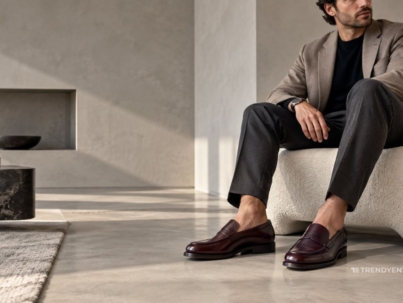
The man with quiet presence moves differently. He doesn’t rush. He doesn’t hover or fidget. He walks with direction as if he knows where he’s going and has already decided he’ll get there. He sits with stillness. He occupies space without apologising for it.
This purposeful movement is not performance. It’s the outward expression of an interior state. When you are genuinely settled and self-possessed, your body shows it automatically. But the reverse is also true: how you move trains how you feel. The man who practices stillness, who slows his walk, who breathes before entering a room – he becomes calmer in the process.
The clothes, of course, matter here. A man who has dressed with intention carries himself differently from a man who grabbed whatever was at hand. When you know your outfit is right for the room your body language shifts.
How to develop it:
Walk at 20% slower than your instinct. This alone reads as composed, deliberate, and unhurried.
When you enter a room, pause for one second at the threshold. Orient. Then move. This micro-habit projects tremendous control.
Sit back in your chair, not forward. Leaning forward reads as eager. Settled and upright reads as assured.
Make eye contact with intention: not a stare, but contact held for one beat longer than average before you break it naturally.
Minimise unnecessary movement: the phone-checking, the self-touching, the shifting weight. Stillness is presence. Motion without purpose is noise.
The right clothing reinforces this. A man who knows his silhouette stands differently.
✦ Dress for Your Body, Not a Mannequin
Find your exact body shape and get a personalised 12‑piece capsule wardrobe, outfit formulas, and a printable shopping checklist.
The reason quiet presence is so rare is that it requires integration – not just one of these traits, but all five, operating simultaneously.
Deliberate speech without emotional gravity becomes bluntness. Undivided attention without personal standards becomes people-pleasing. Purposeful movement without interior stillness becomes studied performance.
But when these traits compound the result is unmistakable. He becomes the kind of person other people describe as having “something about him.” That something is the full integration of composure, attention, conviction, and depth.
It cannot be faked. But it can be built. One deliberate habit at a time.
You develop a commanding presence through stillness, not silence. Enter rooms with a momentary pause before moving. Sit without fidgeting. Make sustained, intentional eye contact.
Quiet confidence is grounded in genuine self-knowledge and consistent behaviour. The quietly confident man doesn’t need others to validate him, so he doesn’t seek approval.
Unforgettability is almost never about the most interesting thing a man said. It’s about how he made other people feel in his company – specifically, whether they felt genuinely seen, respected, and at ease.