The Confident Man Blueprint: Presence, Charisma and Personal Style
Confidence is the most talked-about trait in modern masculinity and the least understood. Most advice on the subject collapses into one of two unhelpful extremes either vague platitudes about “believing in yourself,” or a checklist of purchases that promise to manufacture confidence from the outside in. Neither holds up under scrutiny.
What actually builds a man’s presence is a combination of things that rarely get discussed together: the non-physical signals that make someone read as composed and grounded, and the small, deliberate decisions about what he wears, carries, and puts into his body that reinforce that same impression.
This guide treats both as part of one system, because that’s what they actually are. A man can master every principle of quiet presence and still get read incorrectly if his watch is falling apart and his skin shows the effects of three years of poor sleep and worse food.
What Confidence Actually Is And What It Isn't
Start with a distinction that gets blurred constantly: confidence is not the absence of nervousness, and it is not the same thing as being loud, dominant, or the centre of attention. Some of the most genuinely confident men in any room are the quietest people in it. Confidence, properly understood, is the internal sense that you can handle whatever situation you’re in not because you’ve eliminated all uncertainty, but because you trust your own judgment enough to navigate it as it unfolds.
This distinction matters because it changes what you should actually be working on. If confidence were about eliminating nervousness, the advice would be about suppression techniques. If it’s about trust in your own judgment, the advice is about building a track record with yourself making decisions, following through, and accumulating the kind of self-knowledge that can’t be faked or shortcut.
The signals that communicate this internal state to other people are largely non-physical. They’re about how you occupy space, how you respond to silence, how steady your attention is. The full breakdown of these specific traits, including the ones most men have never consciously identified despite recognising them instantly in others, is covered in How to Build Quiet Presence: 5 Non-Physical Traits That Make You Unforgettable.
The Difference Between Confidence and Charisma
Confidence and charisma get used interchangeably, but they’re doing different jobs. Confidence is largely internal your relationship with your own judgment and capability. Charisma is the externally visible quality that makes other people want to be around you, listen to you, and remember you after the interaction ends.
Clothing habits have a direct, measurable effect on confidence by eliminating everyday friction rather than relying on vague psychological factors. If you want to elevate your overall appearance, learning how to lace dress shoes correctly is one of those small details that quietly separates well-dressed men from everyone else.
This is closer to what’s sometimes called masculine aura — a term that gets thrown around loosely but actually describes something specific: a composite of posture, vocal tone, eye contact, and the underlying self-possession that makes a man read as settled in his own identity rather than constantly seeking validation for it. The seven specific techniques for developing this — practical, not theoretical — are laid out in How to Enhance or Improve Your Masculine Aura.
The Visible Layer: Why Accessories Are Part of This Conversation
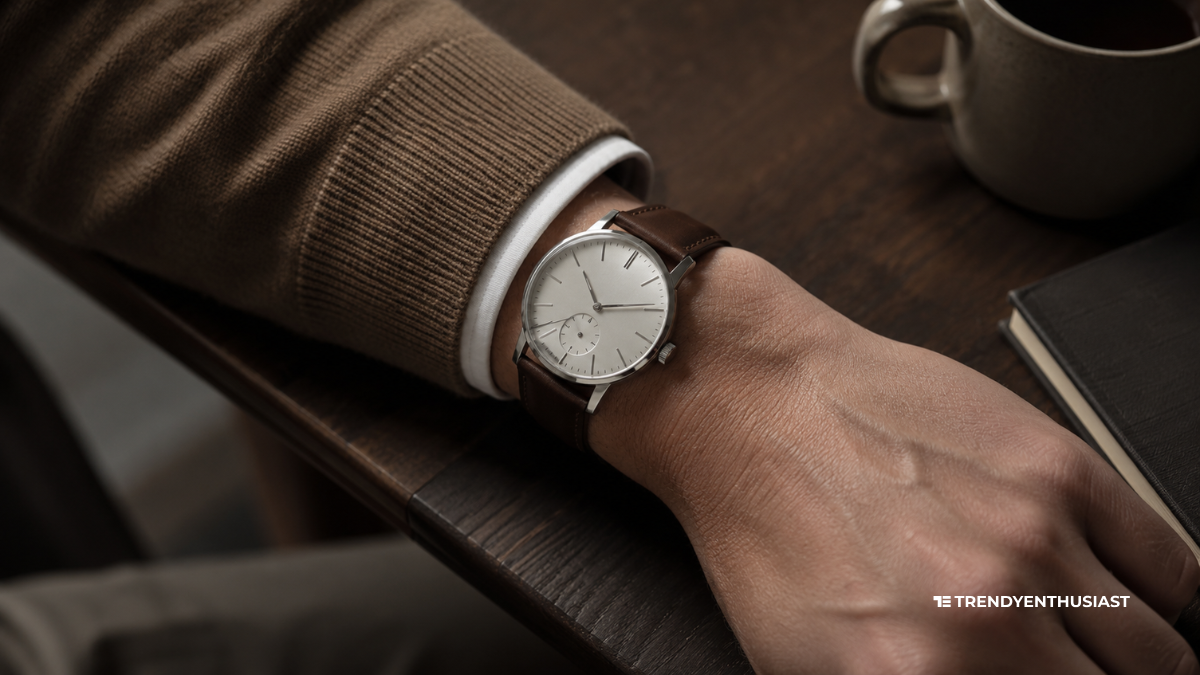
Here’s where this guide makes a claim that deserves justification rather than just assertion: the watch on your wrist and the sunglasses on your face are not superficial additions to confidence. They’re part of the same signalling system as posture and eye contact just operating through a different channel.
For the specific watch recommendations that hold up under this standard see The Best Affordable Luxury Watches in the UK and, for a more understated, minimalist direction entirely, Top 5 Minimalist Watches for Men UK. Both approaches are valid; which one fits depends on the rest of your personal style, not on which is objectively “better.”
The same principle extends to eyewear, where the quality of the frame and the deliberateness of the choice matter more than the size of the logo on the arm. The full breakdown of what actually works, and why most men get this one wrong, is in See Clearly, Look Sharp: The Best Sunglasses for Men in the UK.
The Physical Foundation Most Confidence Advice Ignores
There’s a layer underneath all of this that almost no confidence-focused content addresses directly, and it’s arguably the most foundational of all: the physical state you’re actually operating from. Posture, vocal steadiness, and the energy that reads as presence in a room are all, to a meaningful degree, downstream of how well your body is actually functioning, sleep quality, nutritional adequacy, baseline energy levels.
This isn’t a claim that supplements alone build confidence. It’s a narrower, more defensible claim: a man operating on chronic sleep deprivation and nutritional gaps is working with a depleted physical foundation, and no amount of posture coaching or eye-contact practice fully compensates for a body that’s running on insufficient resources.
This is a more practical, less glamorous piece of the puzzle than most men expect to find in a guide about presence and charisma but it belongs here precisely because it’s so consistently left out elsewhere. For where to source the basics reliably, see Best Online Supplement Store UK not as a shortcut to confidence, but as one practical piece of maintaining the physical foundation everything else in this guide depends on.
How These Pieces Actually Work Together
None of these five posts function as a standalone solution. A man who has internalised every principle of quiet presence but neglects his physical foundation will find his composure harder to access on the days his body isn’t cooperating.
The order that tends to work best: start internal. Build the foundation of quiet presence and the specific techniques behind a grounded masculine aura this is the unglamorous, compounding work, and it’s also the part that nothing external can substitute for.
That’s the complete picture this guide is built around. Confidence isn’t a single technique or a single purchase. It’s the alignment of how you carry yourself internally, how well your body is actually supporting that.