The essential table manners every man should know are: napkin on the lap before anything else, cutlery used from the outside in, bread plate always on the left, wine glass always on the right, elbows off the table while eating, never start before the host or before everyone is served, and the fork and knife rested in the finished position — parallel across the plate — when the meal is done. These are not Victorian formalities. They are a shared language. The man who knows them moves through a formal meal without friction. The man who does not spends the evening making small errors that other people notice and he does not.
This guide covers every rule worth knowing, why each one exists, and the specific situations most men find uncomfortable. Not because your grandmother said so. Because the dinner table is still one of the clearest arenas in which a man is assessed — by a potential employer, a client, a first date, or a family he wants to impress — and most men have never been properly taught what the assessment looks for.
There is a version of this conversation that treats table manners as antiquated — a hangover from a class system that no longer operates the way it once did, a set of arbitrary rules designed to make outsiders feel unwelcome.
That version is wrong, and worth addressing directly.
Table manners exist for two reasons that have nothing to do with class or Victorian formality. The first is practical: a set of shared conventions for how a group of people eat together reduces friction, prevents accidents, and allows everyone at the table to focus on the conversation rather than the logistics. The second is social: how a man behaves at a table reveals how he navigates a structured environment — whether he is aware of others, whether he follows context-specific conventions, whether he is comfortable or anxious in situations that have rules.
Neither of these reasons is arbitrary. Both are still entirely relevant.
The observation I keep returning to, having eaten at enough different tables to see the pattern clearly: the men who are most comfortable in formal dining contexts are not always the men who grew up with formal dining. Many of them learned it deliberately, at a specific point in their lives, because they understood that it was worth knowing. The self-made man who took the trouble to learn these things is indistinguishable from the man who was raised with them. That is the point.
The first thirty seconds at a table communicate a great deal. The man who sits down and immediately handles the table correctly reads as someone who has been in this room before.
The napkin: As soon as you are seated — or when the host places theirs on their lap, whichever comes first — take the napkin from the table or plate, unfold it, and place it across your lap. Not tucked into a collar. Not left on the table beside the plate. In your lap. This is the first visible signal and one of the most frequently missed.
Use the napkin to dab — not wipe — your mouth throughout the meal, particularly before drinking. If you need to leave the table temporarily, place the napkin loosely on your chair. When the meal is finished, place it loosely — not folded, not crumpled — to the left of the plate.
Reading the place setting: Most of the anxiety around formal table settings disappears once one rule is understood — work from the outside in. The cutlery furthest from the plate is for the first course. As courses proceed, you move inward. If a piece of cutlery arrives with a course, use that piece for that course. The place setting is chronological.
The bread plate and the wine glass: The bread plate is always on the left. The drinks are always on the right. A reliable mnemonic: hold both hands in front of you, thumbs and forefingers touching to form two shapes — the left hand makes a lower-case “b” for bread, the right makes a “d” for drinks. In a crowded setting this eliminates the awkward moment of reaching for someone else’s roll.
The way a man holds his cutlery is one of the most immediately visible aspects of his table manner — and one of the most frequently unaddressed.
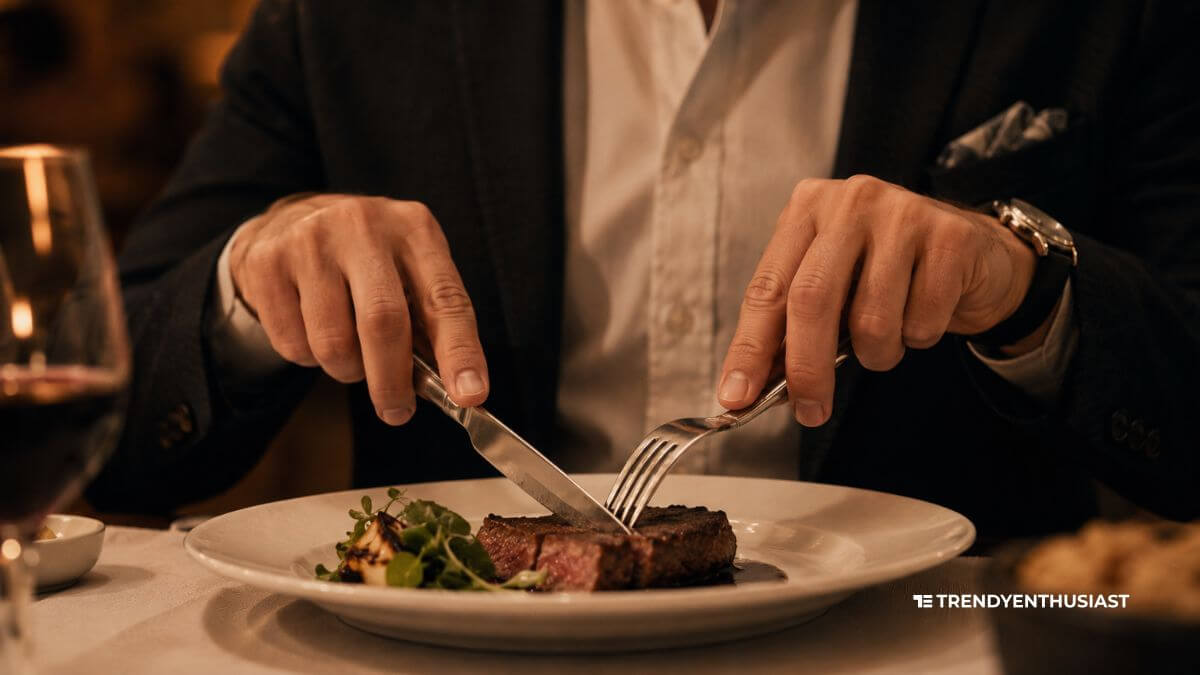
The correct grip: The fork is held in the left hand, tines pointing down, the handle resting in the lower fingers with the index finger extended along the back of the handle. The knife is held in the right hand, blade pointing down, the same lower-finger grip with the index finger extended along the back of the handle. Food is cut and pushed onto the fork, which remains in the left hand with tines down throughout. The fork is not transferred to the right hand after cutting — that is the American style, perfectly acceptable in an American context, but in a formal British or European setting the European style above is the default.
Resting position: When pausing mid-meal — to speak, to drink, to allow a moment to pass — place the fork and knife on the plate in an inverted V shape, points touching in the centre of the plate, handles resting at the four and eight o’clock positions. This signals to the waiter that the meal is in progress.
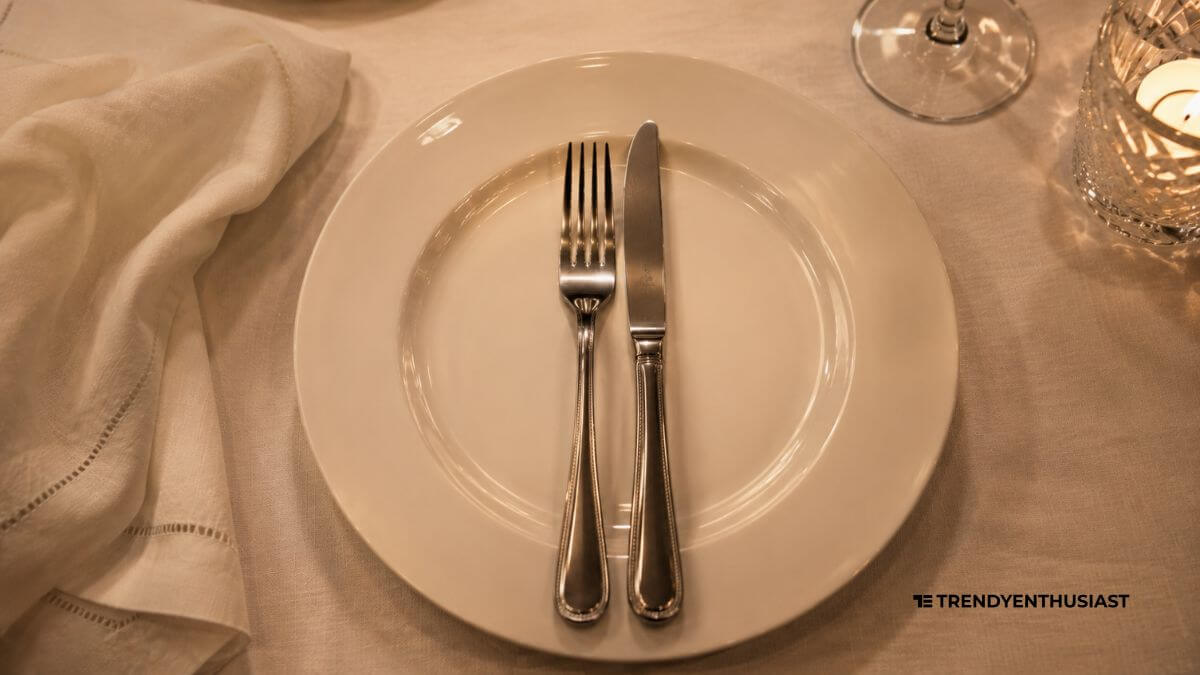
Finished position: When the meal is complete, place the fork and knife parallel to each other — tines up — at the six o’clock position on the plate, handles toward you. This is the international signal for the plate to be cleared. A waiter who knows what he is doing will not ask. He will see it and act.
On soup: The soup spoon is moved away from you through the bowl and sipped from the side of the spoon — not the tip. The bowl is tilted away from you to reach the last of the soup, not toward you. The spoon rests on the soup plate beneath the bowl between sips, not left in the bowl.
The bread plate is the source of more unintentional table errors than almost any other element of the place setting — specifically, taking someone else’s plate or their bread.
The bread plate is on the left. Always. The drinks are on the right. If the person to your left has already taken the wrong plate and used it, politely signal a waiter for a replacement rather than reaching across or using the plate on your right, which belongs to the person beside you.
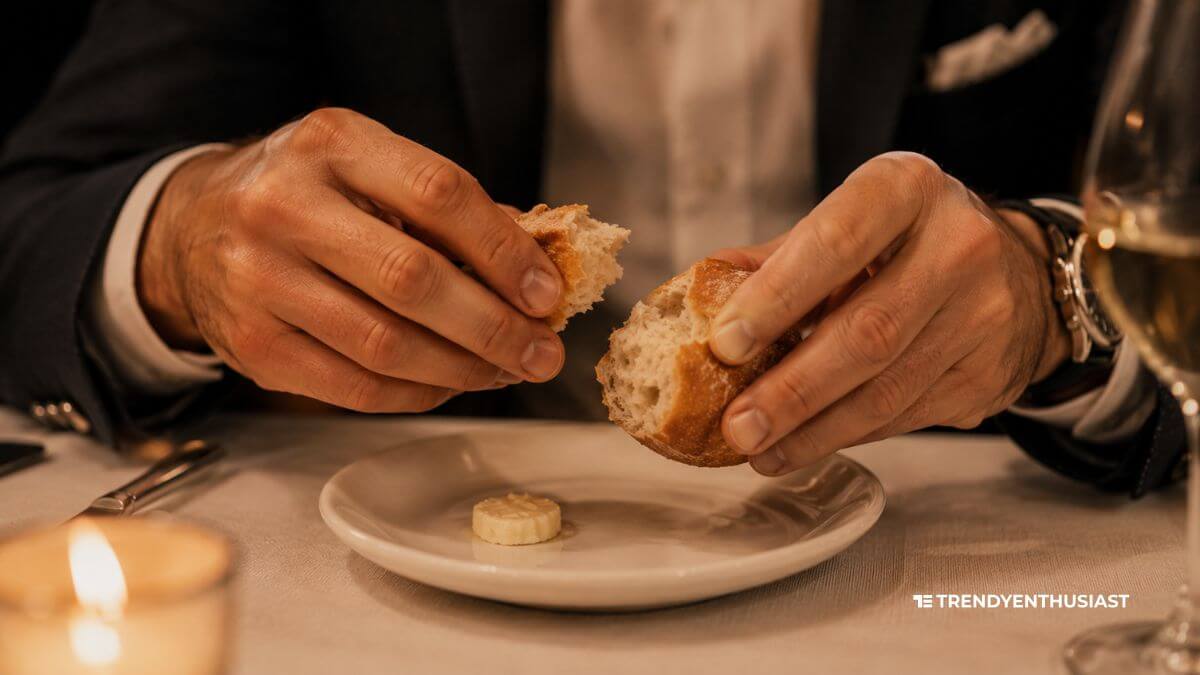
Tearing vs cutting: Bread at a formal table is torn, not cut. Take a small piece from the roll — one bite at a time — and butter that piece using the butter knife from the bread plate. Do not butter the entire roll and take bites from it. Do not hold the roll in one hand while buttering it with the other as if making a sandwich. Tear. Butter each piece individually. This is not fussiness. It is the convention.
The butter knife: The small knife on the bread plate is exclusively for bread. It does not touch the main plate and is not used for anything else.
These are the elements of table manner that etiquette guides frequently omit because they are so fundamental that they are assumed. They are, in practice, the elements most often missed.
Do not start eating before everyone is served — or before the host begins. In a formal setting, wait for the host. At a restaurant with a group, wait until the full table has been served before lifting a fork. The exception, at a large table where courses arrive at different times, is when the host explicitly invites those who have been served to begin.
Elbows off the table while eating. Between courses, with no food in front of you, leaning on the table is acceptable. While eating it is not. The elbows stay off and the posture stays upright — not military straight, but not slumped either. How a man sits at a table is part of the impression he creates.
Do not reach across the table. Ask for items to be passed. “Could you pass the salt?” — then place the salt down rather than handing it directly into the other person’s hands, which is the convention at a formal table. The same for bread, condiments, or anything beyond arm’s reach.
Mouth closed while chewing. This requires no further explanation.
No phone on the table. In 2026 this remains a firm rule at any table where the setting calls for full attention. A phone placed face-up on the table signals that something else has a claim on your attention. That signal is received by everyone sitting with you.
Conversation timing: Do not begin a sentence while chewing. Do not speak with food in the mouth. If you have been asked a question while eating, a raised finger and a brief pause while you finish is entirely acceptable. Attempting to speak through a mouthful is not.
A man does not need to be a sommelier to handle wine at the table correctly. A small number of conventions covers most situations.
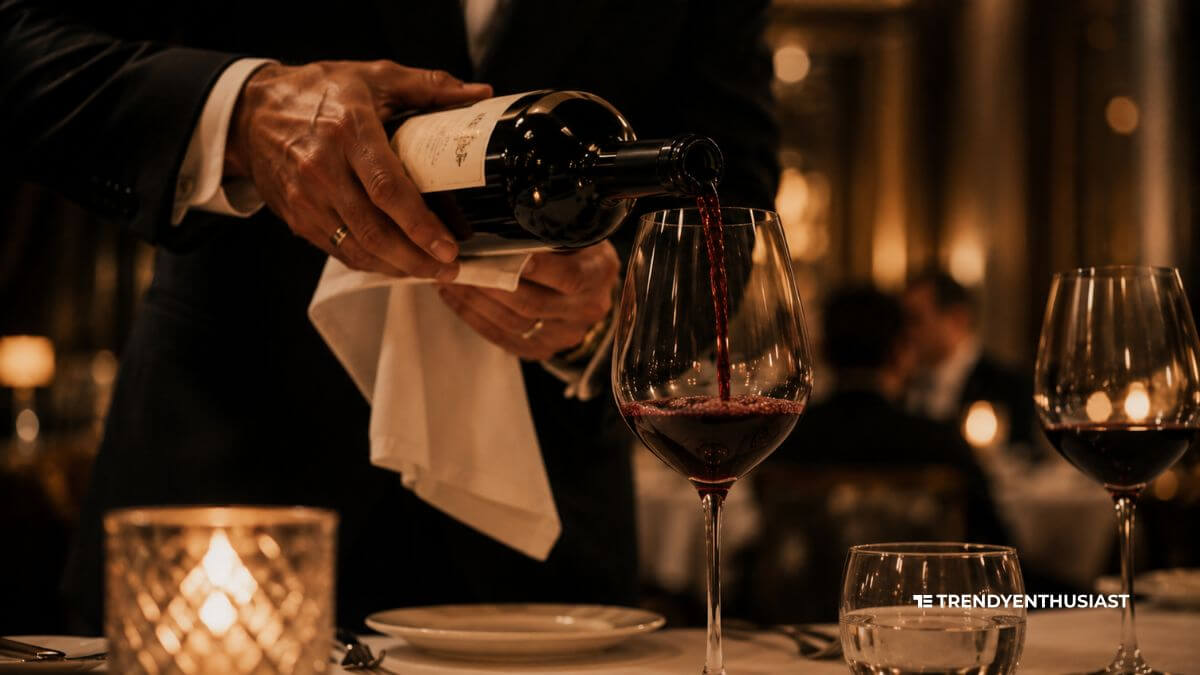
Tasting the wine: When the sommelier or waiter presents the wine for tasting, the person who ordered swirls briefly, smells, and takes a small sip. The purpose of the tasting is to check for faults — specifically, whether the wine has turned or corked — not to assess whether you like the wine. If it is correct, say yes. If it tastes unmistakably of wet cardboard or vinegar, it is corked and you are entitled to a replacement.
Pouring: At a restaurant, allow the waiter or sommelier to pour. Do not reach for the bottle and pour yourself. At a private dinner where a host is pouring, do not pour your own wine before others at the table have been served.
How full: A wine glass at a formal table is filled to approximately one third — never more than half. This is not about rationing. It is about allowing the wine to breathe and to be swirled without spillage.
The non-drinker: If you do not drink, turn the wine glass over or simply say quietly to the person pouring: “Not for me, thank you.” There is no need for explanation and no expectation that you will drink something you do not want.
Water: Keep your water glass in use throughout the meal. A man who eats a full formal meal without touching his water glass is either dehydrated by choice or not paying attention. The water glass is there to be used.
The bill situation at a formal business or social dinner is the moment that tests composure most directly — specifically, the uncomfortable arithmetic of who pays, who offers, and how the negotiation is handled without making it the most memorable moment of the evening.
The rule is simple: whoever invited, pays. If you issued the invitation — for a business dinner, a first date, a social occasion — you pay. Without hesitation, without the theatrical reach for separate cards, without the comedy of two men batting the bill folder between them for three minutes. You invited. You pay. That is the convention.
When someone else has invited you and insists on paying, accept gracefully. A brief genuine thank-you is the correct response. Prolonged protest is performative and uncomfortable for everyone.
When the bill is genuinely to be split, the conversation happens before the bill arrives — not during the uncomfortable silence after the folder lands on the table. “Shall we split this?” asked between the main course and dessert is significantly more elegant than the negotiation that happens under time pressure at the end.
The rules above belong to every table — from a business lunch to a wedding reception to a first dinner at a fine restaurant. The context changes the register. The principles remain the same.
For the specific London rooms worth knowing — where a gentleman dines for a client dinner, a first date, or an occasion that requires a room equal to the effort of showing up correctly — the Cultured Diner Recommender finds the right restaurant for any occasion, group size, budget, and area. It also includes dress code guidance — so the preparation is complete from the table manner to the outfit to the reservation.
The man who arrives at a fine table knowing what to do — with his napkin, his cutlery, his wine glass, and his phone — is the man the room remembers correctly. Not because he performed anything. Because he was simply, quietly, at ease.
The essential table manners for men are: napkin on the lap immediately upon sitting, cutlery used from the outside in as courses progress, bread plate on the left and drinks on the right, elbows off the table while eating, waiting until all guests are served before beginning, mouth closed while chewing, no phone on the table, and placing the fork and knife parallel at six o’clock when finished. These conventions apply across formal and semi-formal dining contexts and are the baseline of competent behaviour at any table that requires it.
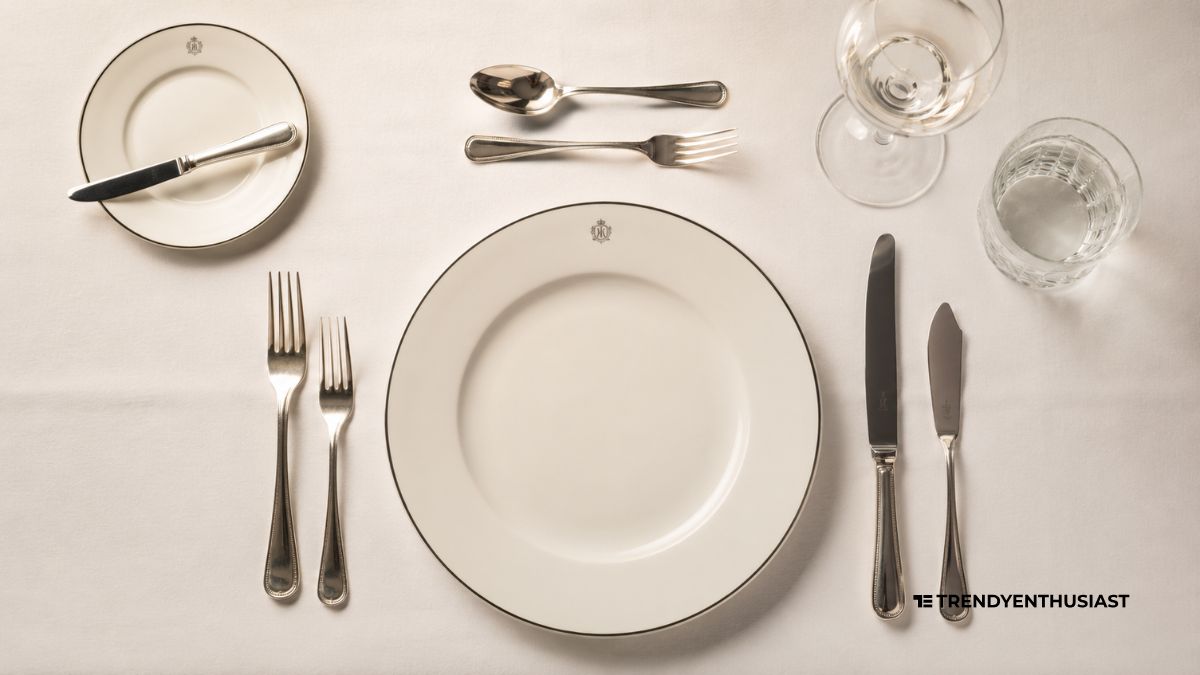
The bread plate is always on the left. A reliable method for remembering: hold both hands in front of you with thumbs and forefingers touching — the left hand forms a lower-case “b” for bread, the right forms a “d” for drinks. In any place setting, the bread plate is to the left of the main plate and the drinks are to the right. This is the cause of more unintentional table errors than almost any other element — specifically, taking the bread plate belonging to the person beside you.
The fork is held in the left hand with tines pointing down, the handle resting in the lower fingers with the index finger extended along the back. The knife is held in the right hand with the blade pointing down, the same grip. Food is cut and pushed onto the fork, which stays in the left hand throughout — the fork is not transferred to the right hand after cutting. When resting mid-meal, the fork and knife form an inverted V on the plate at four and eight o’clock. When finished, they rest parallel at six o’clock, tines up.
The position of cutlery on the plate communicates to service staff whether the meal is in progress or complete. The resting position — an inverted V at four and eight o’clock — signals that you are still eating and the plate should not be cleared. The finished position — fork and knife parallel at six o’clock, tines up — signals that the meal is complete and the plate may be cleared. A competent waiter reads this without asking. The convention removes the need for verbal communication in either direction.
At a formal business dinner, a first date, a family occasion, or any table where the setting calls for full attention, no. A phone placed face-up on the table signals that something else has a priority claim on your attention — that signal is received and registered by everyone at the table. In 2026 the expectation at formal or semi-formal dinners is that the phone is in a pocket and checked, if at all, during a break away from the table. The phone-on-table habit is one of the most common and most negatively received table manner failures in contemporary dining.
Knowing the rules is not about performing them. It is about being so familiar with them that they require no thought — and all your attention can go to the conversation and the person across the table. That is the actual point.
Next in the Confident Man series: Dining Etiquette for Men (coming soon) | How to Build Quiet Presence | How to Enhance Your Masculine Aura
Founder and Editor of Trendy Enthusiast. Ali covers men's fashion, lifestyle, grooming, and the art of dining well - blending real experience with practical insight.
Connect on Instagram